
Siding is not the part of the wall that keeps water out. The real protection is the layer behind it: a water-resistive barrier, usually house wrap or building felt, lapped so water runs down and out, plus flashing at every window, door and roof-to-wall corner. Installed in the right order, they let water behind the siding drain away. Installed wrong, they let it soak into the sheathing and framing.
What does house wrap actually do?
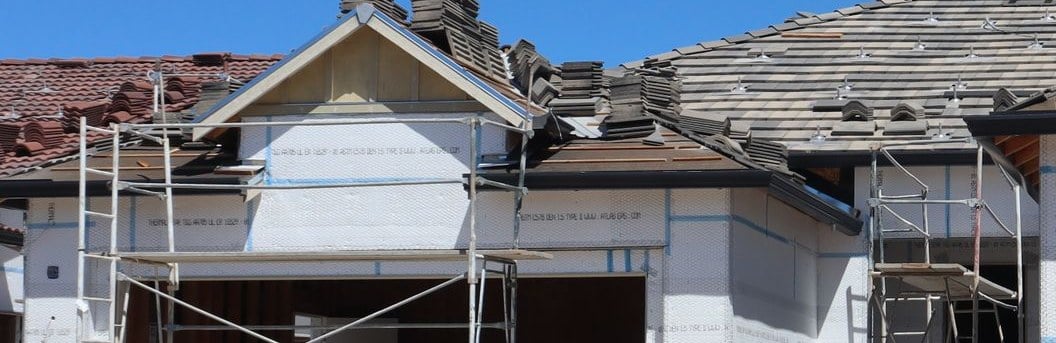
House wrap is a sheet that goes over the wall sheathing before the siding. It sheds liquid water that gets past the siding, which wind-driven rain always does to some degree, while letting water vapor pass so the wall can dry.
The City of Austin has adopted the 2024 International Residential Code, per its building technical codes page. The wall chapter (2024 IRC Chapter 7) says the exterior wall must be built to keep water from building up inside it, using two things together: a water-resistive barrier behind the cladding and a way for water that gets behind the cladding to drain back outside.
Section R703.2 asks for at least one layer of barrier over the studs or sheathing on all exterior walls. It has to be continuous, including behind deck ledgers and up to the top of the wall. Approved materials include No. 15 asphalt felt, house wraps that meet ASTM E2556, and certain foam sheathing systems installed per the maker’s instructions.
Is house wrap the same as a vapor barrier?
No, and in Austin the difference matters. A vapor barrier is meant to stop moisture vapor from moving through the wall. House wrap is designed to let vapor through while stopping liquid water.
Travis County is in climate zone 2A, a hot and humid zone, per the county table in the Austin energy code viewer. For zones 1 and 2, the IRC’s vapor retarder table (R702.7) does not permit Class I or Class II vapor retarders on the interior side of frame walls. Class I includes plastic sheeting and foil. Class II includes kraft-faced batts. Latex or enamel paint, a Class III retarder, is allowed, and the code says a vapor retarder is not required at all in zones 1 through 3.
The reason: here the air conditioning keeps the inside cool and dry while the outside is hot and damp. A plastic sheet on the inside face of the wall can trap moisture from outside right where it cools and condenses.
How should the layers overlap?
Every layer on the wall should go on shingle fashion: the upper piece laps over the lower one, like shingles on a roof, so water running down always lands on the outside face of the next layer.
The code spells this out for felt and E2556 house wraps. They go on horizontally, the upper layer lapping over the lower one by at least 2 inches, with vertical joints lapped at least 6 inches.
Section R703.4 also requires corrosion-resistant flashing in shingle fashion at the places water likes to get in. That includes windows and doors, above projecting trim, where decks or porches attach, and where a wall meets a roof.
What is the right order for window flashing?
Windows and doors are a common place for water to get into a wall. Section R703.4.1 says to follow the window maker’s flashing instructions. When there are none, the opening needs pan flashing at the sill that drains to the outside, with the head and sides flashed too.
The Department of Energy’s Building America guide, Windows and Doors are Fully Flashed, lays out a sequence that matches most product instructions:
- Cut the house wrap over the opening in a modified “I,” fold the sides and bottom into the opening, and fold a flap up at the head.
- Install sill or pan flashing first, often with a small back dam at the inside edge.
- Seal the head and sides of the opening, but do not seal across the sill, so any water that gets in can drain out.
- Set the window, then add flashing at the sides, then at the head.
- Fold the head flap down over the head flashing and tape it.
- Seal the gap between the window and the framing from the inside.
The key detail is step 5: the wrap above the window goes over the head flashing, not under it, or water running down the wrap gets funneled behind the window.
Why do kickout flashings matter so much here?
Where a lower roof meets a sidewall, rain runs down the roof and pours off at the corner where the roof edge ends against the wall. The 2024 IRC section R903.2.1 (IRC Chapter 9) requires a flashing that diverts water away from that spot. That piece is the kickout. Metal flashing must be corrosion resistant and at least 0.019 inch thick.
The National Weather Service Austin climate summary notes that thunderstorms here can drop large amounts of rain in short periods, at times more than 5 inches in several hours. A missing kickout sends that water straight behind the siding. The DOE’s guide on step and kick-out flashing also points out that fiber cement, vinyl and brick can hide water damage for years.
What can you check yourself?
You don’t need a contractor for a first look. From the ground or a safe spot, check these:
- Roof-to-wall corners. Where a roof edge dies into a wall, look for an angled kickout piece aimed into the gutter. Staining or soft siding below that corner is a warning sign.
- Window heads. Look for a metal or vinyl drip cap above the trim. Streaks or peeling paint under a window corner are worth noting.
- Window sills. If someone has caulked the bottom edge shut, do not add more. That joint is often meant to drain.
- Deck ledgers. Check where the deck meets the house for flashing over the board. Rot on the board below can point to a missing one.
If everything looks tight and there are no stains, soft spots or musty smells, you may not need anything beyond normal caulk and paint upkeep. Small trim and soffit repairs are on the City of Austin’s list of work exempt from building permits, but exempt work still has to meet the code.
When is it time to open the wall?
Call a contractor for soft sheathing, repeated staining under one window, or a roof-to-wall corner with no kickout. Fixing flashing usually means removing some siding so the repair can be lapped correctly, not just sealed on the surface. If the siding is coming off anyway for a siding replacement, that is a good time to redo the wrap and flashing.
Get the wall behind your siding checked
Ridgepoint Solutions works on siding and exteriors in Austin and surrounding Central Texas communities. If you see staining at a window or a roof corner, or you are planning new siding, Get a free estimate or email info@ridgepoint-solutions.com. Ask for the barrier and flashing details to be written into the scope.
Frequently asked questions
Do I need new house wrap when I replace siding?
Often, yes. Once the old siding is off, the existing barrier is exposed and often torn, brittle or missing in spots, especially around windows. Patching old wrap can work for small areas, but a full replacement lets the installer lap every sheet in the correct order and tie it into new window and door flashing.
Is house wrap tape enough to seal the seams?
Tape helps, but it is a backup, not the main defense. The code relies on shingle-fashion laps, with upper sheets over lower ones, so water drains even if tape lets go over time. Tape is useful on vertical seams, around penetrations and over the head flap above a window. If the laps are backward, tape is the only thing holding water out, and it was never meant to carry that job alone.
Should I put plastic sheeting behind my walls to stop humidity?
Not in Austin. Travis County is in climate zone 2A, and the 2024 IRC does not permit Class I vapor retarders like plastic sheeting or Class II retarders like kraft-faced batts on the interior side of frame walls in zones 1 and 2. In a hot, humid climate, an inside plastic layer can trap moisture where it cools and condenses. House wrap on the outside and good drainage are the better path.