Commercial · Ridgepoint Solutions
PVC roofing in Austin, TX
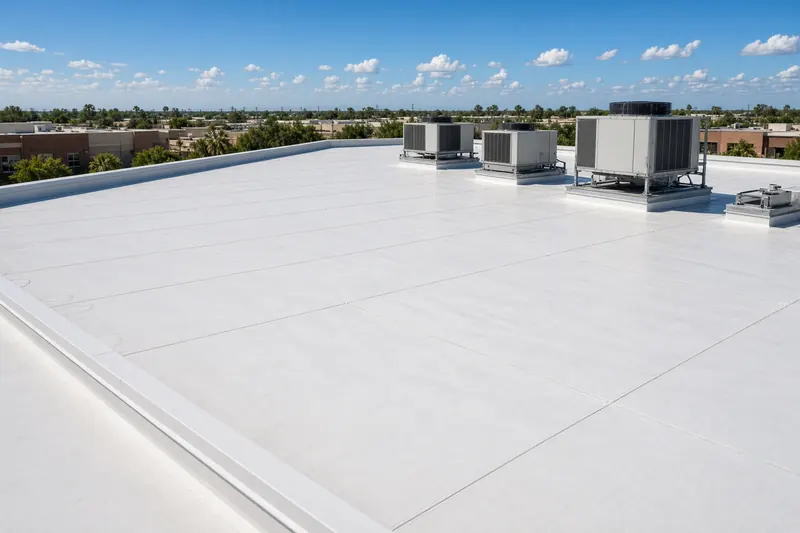
PVC (polyvinyl chloride) is a single-ply roofing membrane with heat-welded seams. Its main advantage over TPO is resistance to grease, oils and many chemicals, which is why it is commonly specified for restaurants, food facilities and buildings with rooftop exhaust.
What PVC is
PVC membranes are made from polyvinyl chloride with plasticizers and a reinforcing fabric scrim. Like TPO, the seams are welded with hot air to form a continuous waterproof surface. PVC is flexible, which helps on roofs with curves and many details.
Where PVC is the better choice
- Restaurants and commercial kitchens, where grease from exhaust fans lands on the roof
- Manufacturing and food-processing buildings with chemical exhaust
- Roofs with ponding water, where PVC's resistance to constantly wet conditions helps
- Buildings with many penetrations and details, where its flexibility is an advantage
- Where fire resistance is a priority: PVC is inherently fire-resistant
Seams, flashing and details
PVC flashing details can be prefabricated or built on site. The weakest points on any single-ply roof are the flashings and seams. Careful welding and inspection of each seam, with probe tests, is part of the installation. Edges and terminations need to be tied down properly for wind.
Reinforcement and thickness
PVC membranes are sold in a range of thicknesses and with different reinforcement. Heavier scrim and thicker membranes resist punctures and tears better, but cost more. Elevate and other manufacturers publish the specifications of each product line.
PVC vs TPO
| PVC | TPO | |
|---|---|---|
| Grease and chemicals | Strong resistance | More vulnerable |
| Typical cost | Usually higher | Usually lower |
| Seams | Heat-welded | Heat-welded |
| Typical choice | Restaurants, food, labs, complex roofs | General commercial and warehouses |
See TPO roofing for the other side of the comparison.
Prefabricated PVC
Some manufacturers build PVC roof sheets to measure in a factory. See Duro-Last roofing for that approach.
Warranty and paying
The membrane manufacturer sets the material warranty. Our labor warranty and manufacturer relationships are on the warranty page. Larger projects can use financing, subject to credit approval.
Commercial warranty basics, and how manufacturer and labor warranties fit together, are on the warranty page.
Paying over time
Financing options are available through lending partners. Financing is subject to credit approval and approval is not guaranteed. See financing options ›
Questions people ask
Is PVC better than TPO?
Not always. PVC performs better around grease and chemicals. TPO often costs less. The right choice depends on the building.
Can PVC be installed over an old roof?
Sometimes, if the existing roof is dry and sound and a compatible separation layer is used. A moisture survey comes first.
How are PVC seams checked?
Seams are probed along their length after welding to find any gaps. We also check the welding temperature and speed as work proceeds.
Does PVC need maintenance?
Yes. Like any roof, it benefits from regular inspections and from cleaning the drains and surfaces.
Related services
- Commercial roofingRepair, restore or replace: the decisions, the systems, and the warranty path for building owners.Read more ›
- TPO roofingOne membrane in depth: seams, attachment, reflectivity and where TPO roofs fail.Read more ›
- Duro-Last roofingA prefabricated PVC system, described from the manufacturer's published material.Read more ›
- Commercial roof repairReactive leak response for owners and property managers, including low-slope repair detail.Read more ›
Where we work
We serve Austin and ten surrounding Central Texas cities, including Austin, Round Rock, Georgetown. Each city page has that city's permit rules and weather records. See all 11 service areas ›
Photos and write-ups of our work will appear on the projects page.
Our promise
Ridgepoint Workmanship Guarantee
A 10-year workmanship warranty on full roof replacements, and up to 1 year on repairs.
- 10-year workmanship warranty on full roof replacements.
- Up to 1 year of workmanship coverage on repairs.
- This warranty covers our workmanship. Manufacturer or material warranties are separate and not part of it.
Get your free estimate
Free inspection and written estimate. Use the form, or call (737) 418-8832.
Request my estimate