Commercial · Ridgepoint Solutions
TPO roofing in Austin, TX
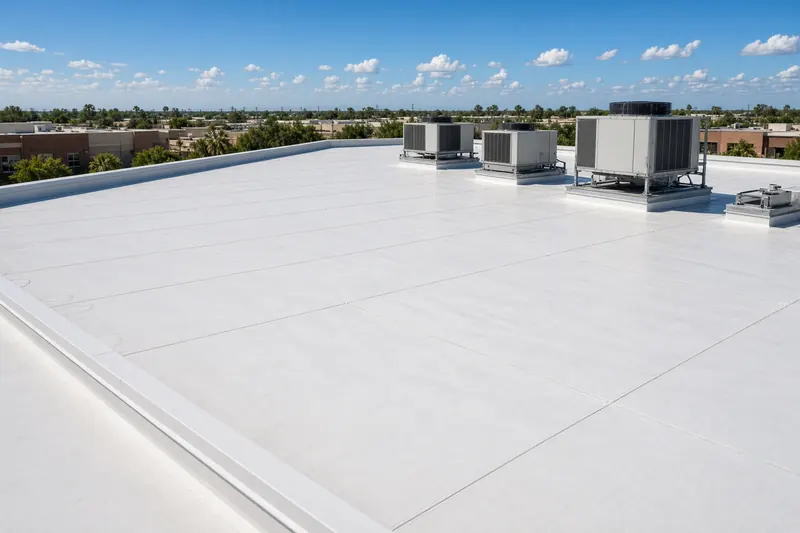
TPO (thermoplastic polyolefin) is a white single-ply roofing membrane whose seams are welded with hot air. It is reflective, widely used on commercial buildings, and also installed on some residential low-slope roofs. Ridgepoint installs TPO on both.
How TPO is built
A TPO roof is a sheet of membrane, typically reinforced with polyester scrim, rolled over insulation and welded at the seams with a hot-air welder. A welded seam fuses the sheets into one surface rather than relying on adhesive or tape.
- Membrane: sold in thicknesses commonly from 45 to 80 mils, in widths up to 12 feet or more
- Insulation: polyiso boards are the usual choice, and they provide most of the roof's R-value
- Attachment: the membrane is mechanically attached, fully adhered, or ballasted, depending on the building and wind requirements
- Flashings: walls, curbs and penetrations are flashed with TPO-coated metal and membrane
Mechanically attached vs fully adhered
| Mechanically attached | Fully adhered | |
|---|---|---|
| How | Screws and plates through the membrane or seam into the deck | Adhesive holds the membrane to the substrate |
| Appearance | Slightly rippled | Smooth |
| Best for | Large, simple roofs | Roofs with complex shapes, or where fastener patterns are a concern |
The manufacturer's specifications and the building's wind-uplift needs decide the method.
Reflectivity and heat
White TPO reflects sunlight, which reduces the heat that reaches the building in a Central Texas summer. How much that lowers cooling costs depends on the building, insulation and use. Dirt reduces reflectivity over time, so a cleaning schedule is part of maintenance.
Where TPO roofs fail
- Seams that were poorly welded or contaminated with dirt
- Flashings at penetrations and walls, which are the most common leak points
- Punctures from foot traffic and rooftop equipment service
- Ponding water at low spots
- Membrane that was not specified for the building's conditions
When they happen, see commercial roof repair.
TPO vs PVC
TPO and PVC look alike and both have welded seams. PVC resists grease, oils and chemicals better, and is often chosen for restaurants and buildings with exhaust. TPO is generally less expensive. See PVC roofing for details.
Residential TPO
TPO is also installed on residential low-slope areas such as flat porch roofs and room additions. The system is the same; the scale and details differ. For the home side, see residential roofing.
Warranty and paying
The manufacturer sets the warranty terms for the TPO membrane and system. Ridgepoint's labor warranty and the manufacturer relationship are on the warranty page. For larger projects, financing is subject to credit approval.
Commercial warranty basics, and how manufacturer and labor warranties fit together, are on the warranty page.
Paying over time
Financing options are available through lending partners. Financing is subject to credit approval and approval is not guaranteed. See financing options ›
Questions people ask
How long does a TPO roof last?
It depends on the membrane thickness, installation quality, exposure and maintenance. Manufacturers publish their warranty terms; ask for the specific product's warranty in writing.
Can TPO go over my existing roof?
Sometimes, with a cover board, if the existing insulation is dry. A moisture survey confirms that before we recommend it.
Is TPO good for restaurants?
Grease and oils can attack TPO. PVC is generally preferred for buildings with kitchen exhaust.
Who warranties a TPO roof?
The manufacturer warranties the membrane, and sometimes the whole system, on its terms. The contractor's labor warranty is separate.
Related services
- Commercial roofingRepair, restore or replace: the decisions, the systems, and the warranty path for building owners.Read more ›
- PVC roofingOne membrane in depth: chemical and grease resistance, welded seams and where PVC is the right choice.Read more ›
- Duro-Last roofingA prefabricated PVC system, described from the manufacturer's published material.Read more ›
- Modified bitumen roofingA multi-layer asphalt-based low-slope system, for commercial and residential low-slope roofs.Read more ›
- Commercial roof repairReactive leak response for owners and property managers, including low-slope repair detail.Read more ›
Where we work
We serve Austin and ten surrounding Central Texas cities, including Austin, Round Rock, Georgetown. Each city page has that city's permit rules and weather records. See all 11 service areas ›
Photos and write-ups of our work will appear on the projects page.
Our promise
Ridgepoint Workmanship Guarantee
A 10-year workmanship warranty on full roof replacements, and up to 1 year on repairs.
- 10-year workmanship warranty on full roof replacements.
- Up to 1 year of workmanship coverage on repairs.
- This warranty covers our workmanship. Manufacturer or material warranties are separate and not part of it.
Get your free estimate
Free inspection and written estimate. Use the form, or call (737) 418-8832.
Request my estimate