
Seamless gutters are formed on site from a coil of metal, cut to the length of each roof edge, so the only joints are at corners, end caps and downspout outlets. Sectional gutters come in fixed lengths that are joined with connectors along the run, and every one of those connectors is a sealed joint that can open up over time. For most Austin homes, fewer joints means fewer places to leak, but a long seamless run still needs a planned expansion joint, and sectional gutters still make sense for some repairs and do-it-yourself jobs.
Here is where gutter leaks actually start, what changes in our heat, and the questions worth asking before anyone hangs new gutters on your house.
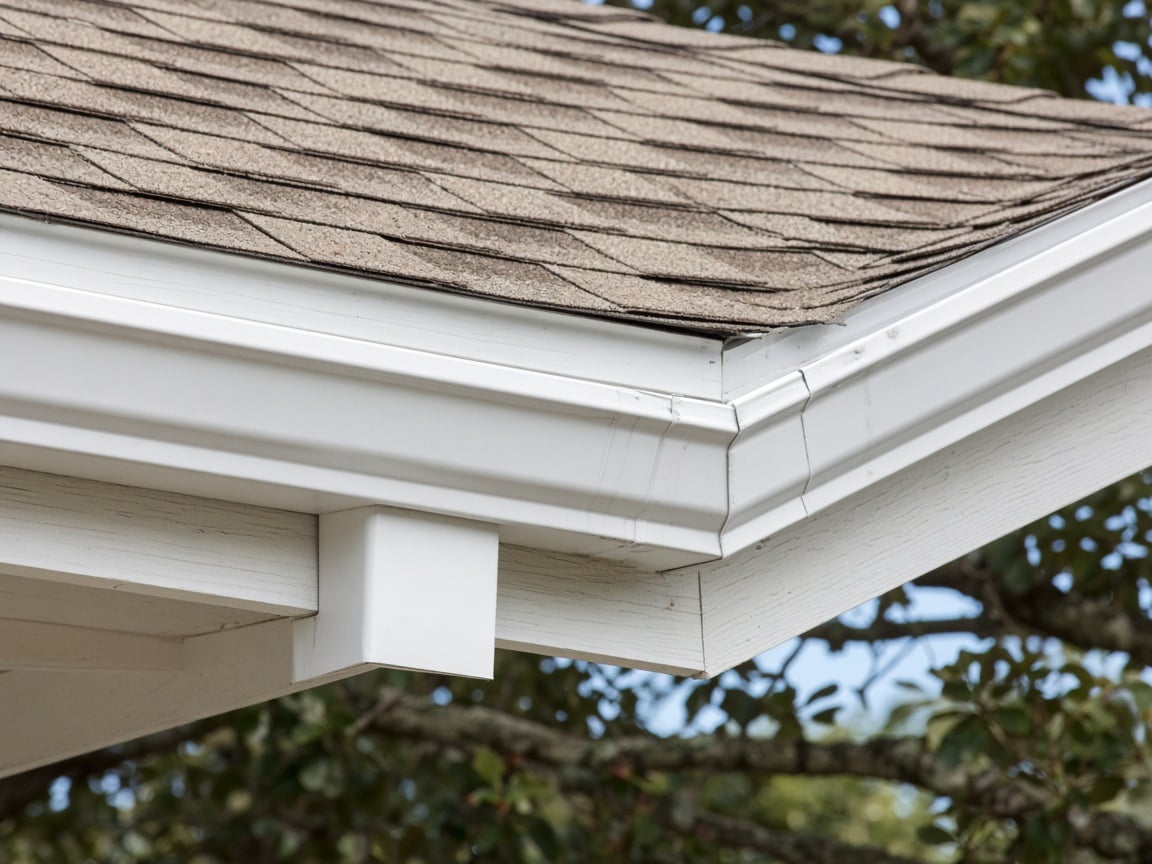
What is the real difference between seamless and sectional gutters?
The difference is how many joints the water has to pass. A seamless installer brings a forming machine to the house and runs flat coil through it, so a 35-foot eave gets one 35-foot piece of gutter. A sectional system is bought in stock lengths and pieced together, with a connector or overlap wherever two lengths meet.
Both systems still have some joints. Corners are joined with miters, the ends are closed with end caps, and each downspout needs an outlet cut into the bottom of the gutter. What seamless removes are the joints in the middle of straight runs. That matters because a joint depends on sealant or cement to stay watertight, and the metal or vinyl around it keeps moving with the weather.
Where do gutter leaks usually start?
Gutter leaks tend to start at joints, because that is where a seal is doing the work instead of solid metal. When you look up after a storm, check these spots first:
- Connectors on sectional runs. The sealant ages and the two lengths pull against each other, so water drips from a line across the bottom of the gutter.
- Corners. A miter is cut and sealed, and it carries water from two directions at once.
- End caps. A cap that was set without enough sealant, or one that took a ladder hit, weeps at the end of the run.
- Downspout outlets. The hole cut for the drop has to be sealed to the gutter, and debris tends to pile up right there.
A leak at a joint can be small, but where the drip lands matters. Water that runs behind the gutter keeps the fascia board wet, which is how fascia rot behind gutters gets started. If the drip falls next to the slab, it adds water exactly where you don’t want it.
Do long seamless runs need an expansion joint in Austin heat?
Often, yes. Gutters grow and shrink as the temperature changes, and the National Weather Service climate summary for Austin describes long hot summers and short mild winters, so a gutter on a sunny eave heats and cools a lot over a year.
An Amerimax Home Products gutter installation manual says expansion joints are essential in all gutter installations and that no gutter length should exceed 50 feet without one. A vinyl gutter maker sets a shorter limit: its installation brochure calls for an expansion connector where a run has 25 feet or more between two corners and no downspout outlet.
There is a catch that affects the whole layout. The Amerimax manual points out that an expansion joint acts as a dam inside the gutter, so the number and placement of downspouts has to be planned around it. On a long eave, that can mean a downspout on each side of the joint. Seamless gutters cut the number of joints. They don’t make thermal movement go away.
When do sectional gutters make sense?
Sectional gutters are not a mistake, they just have more joints to keep up. They can be the simpler choice when:
- You are replacing one damaged length and the rest of the run is in good shape.
- You want to do the work yourself on a short run, like a shed or a small porch roof.
- You are matching an existing profile and color on one side of the house.
If you go the do-it-yourself route, follow the maker’s joint instructions closely. The vinyl brochure above, for example, asks for sanded, clean, dry surfaces and its own cement, says not to apply it below 32°F, and says not to cement the elbows or downspout. Skipping steps like that is how a new connector starts leaking in its first season.
If you have a two-story eave, a steep roof or a run that sits over a walkway, the ladder work is the real risk, and it is usually simpler to hire it out.
What should you ask before replacing gutters?
A good quote should answer these questions in writing:
- Where will the joints be? Ask for a sketch showing corners, outlets and any expansion joints on each run.
- How many downspouts, and where? More outlets on long or busy runs means less water in each section of gutter.
- Where does the water go after the downspout? The Austin Residential Code, section R801.3 in the roof-ceiling chapter, asks homes on expansive soils to discharge roof water at least 5 feet from the foundation walls or into an approved drainage system. Our guide to downspout drainage on Austin clay covers the options.
- Is the fascia solid? New gutters screwed into soft wood won’t hold their pitch. Ask whether bad boards will be replaced first.
On permits: the City of Austin’s list of work exempt from building permits includes repairing or replacing exterior trim such as wood fascia, trim and soffits. Gutters are not named on that list, and exempt work still has to meet code, so if your project is unusual, check with Austin Development Services before you start.
Get a second look before you replace
Ridgepoint Solutions repairs and replaces gutters for homes in Austin and surrounding Central Texas communities. We can walk your roof edges, show you which joints are leaking, and tell you whether a reseal, a new section or a full seamless run makes sense. See our gutter services, or Get a free estimate. You can also email info@ridgepoint-solutions.com.
Frequently asked questions
Are seamless gutters always better than sectional gutters?
Not always. Seamless gutters have fewer joints along straight runs, which removes the most common leak points, so they are usually the better choice for a full replacement. Sectional gutters can make more sense when you are replacing a single damaged length, matching an existing system or doing a short run yourself. Either type still needs sealed corners, end caps and outlets, plus planned expansion joints on long runs.
Why does my gutter drip at the same spot after every rain?
A drip that shows up in the same place after each storm is usually a joint, such as a connector between two lengths, a corner miter, an end cap or the seal around a downspout outlet. Often the sealant there has aged or pulled loose as the gutter moved with the temperature. Cleaning the spot and resealing it often fixes the drip. If the metal is bent or the joint keeps reopening, that piece may need to be replaced.
Can a seamless gutter be repaired if one part is damaged?
Yes. A dent or a leaking corner on a seamless gutter can often be repaired, resealed or patched without replacing the whole run. If a long section is badly bent or pulled off the fascia, an installer can cut out the damaged part and join in a new piece. That repair adds a joint, so it should be sealed carefully and checked after the next heavy rain.